In the public sector, modernization projects often start with a simple idea: upgrade aging infrastructure, improve performance, and keep leadership happy with visible progress. But when the refresh hinges on the “newest gen” OEM hardware, that straightforward plan can quickly turn into a stalled, over-budget headache.
That’s exactly what happened when a US Court District began planning a refresh of its aging Dell PowerEdge R720 production environment. The OEM recommended the newest 17th-generation flagship platform. On paper, it looked ideal. In reality, long lead times and fractured budgets threatened to derail the project altogether.
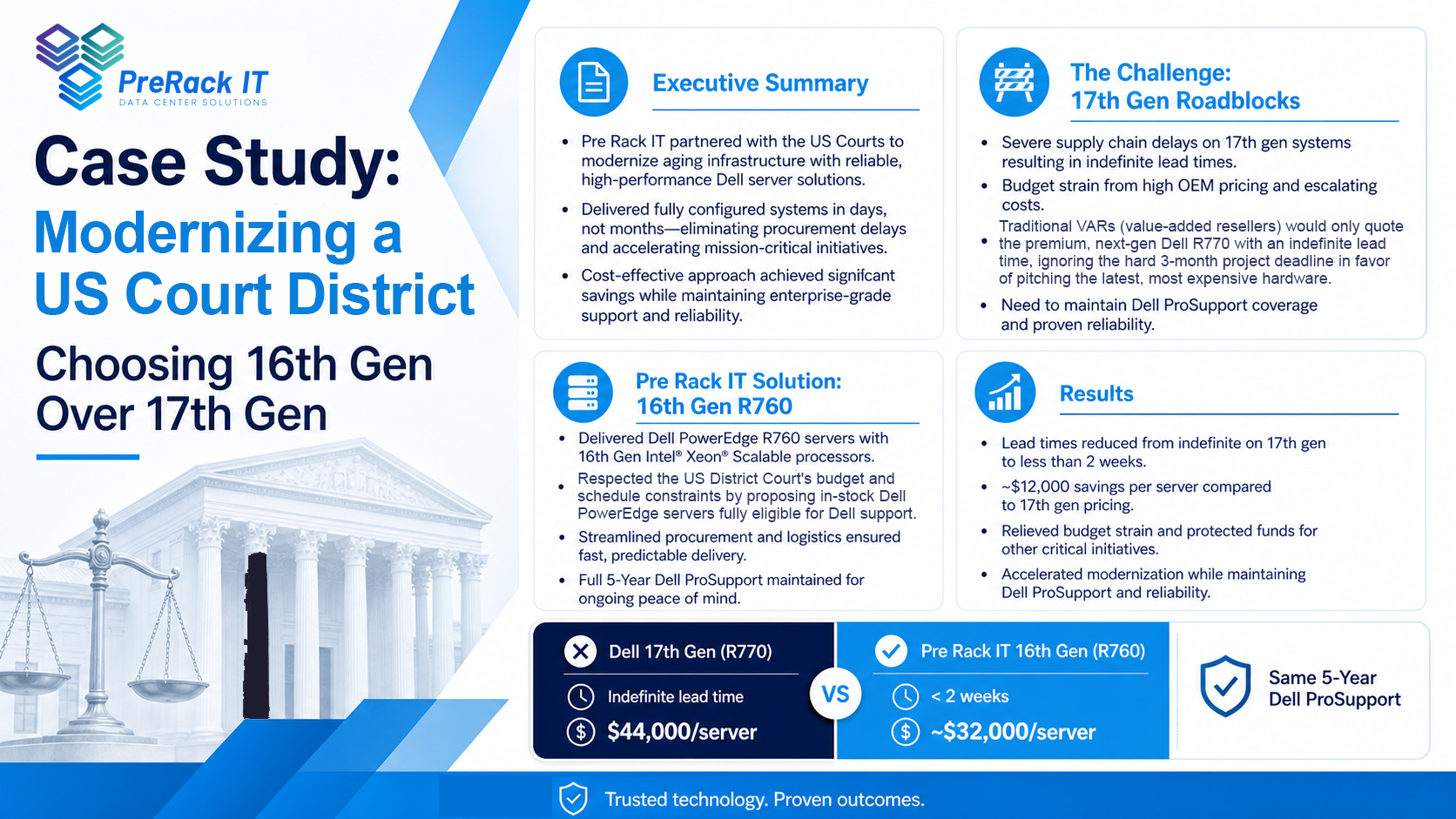
Instead of waiting on hardware that kept slipping into “indefinite” delivery dates, the courts found a better path: leveraging Pre Rack IT to deploy 16th-generation PowerEdge servers with faster lead times, lower costs, and the same enterprise warranty coverage.
This blog breaks down why “latest gen” can be the wrong choice, how N-1 (previous generation) hardware can be a smarter play, and how organizations can use partners like Pre Rack IT to get projects over the finish line on time and under budget.
The Modernization Trigger: Aging Dell PowerEdge R720 Servers
The US Court District’s production environment was still running on Dell PowerEdge R720 servers—solid workhorses in their day, but increasingly outmatched by modern workloads and evolving security and compliance demands.
The IT team knew three things:
- The infrastructure needed a refresh to maintain reliability and performance.
- Leadership expected visible progress toward modernization objectives.
- Any new platform had to comply with federal IT standards and warranty coverage requirements.
The logical starting point was to consult the OEM. When they approached Dell, the manufacturer predictably recommended its newest 17th-generation PowerEdge platform as the go-forward architecture.
On the surface, it made sense:
- Latest CPU generation and performance profile.
- Aligns with Dell’s current flagship roadmap.
- Perceived as “future-proof” for leadership and stakeholders.
But modernization doesn’t happen on paper. It happens within real-world constraints like budgets, supply chains, fiscal-year cycles, and political expectations.
That’s where the plan started to break down.
When “Newest Gen” Meets Real-World Constraints
The recommended 17th-gen hardware came with two major roadblocks: lead time and cost.
1. Lead Time: From “Three Months” to “Indefinite”
The courts were initially quoted a roughly three-month lead time for the 17th-gen servers. That’s not ideal, but often survivable in the context of a planned refresh.
Then the timeline started slipping.
As supply chain realities set in, the estimated delivery window was pushed out further and further until the IT team was finally told there was no guaranteed delivery date. In other words: indefinite.
That created serious problems:
- Project milestones tied to leadership expectations were now at risk.
- Dependencies—such as scheduled cutovers and application migrations—couldn’t be reliably planned.
- Internal stakeholders began to lose confidence that the project would deliver on time.
In public sector environments, where visibility and accountability are paramount, “indefinite” is not a viable status for mission-critical infrastructure effort.
2. Budget: High Price, Split Across Fiscal Years
The second roadblock was cost structure.
The OEM’s 17th-gen quote came in at:
- Around $29,000 per server for the chassis, CPUs, and RAM, and
- Around $15,000 per server for the required storage configuration.
That meant roughly $44,000 per server total.
For the US Court District, this pricing model created a fiscal-year trap:
- The current-year budget could cover the compute portion, but not the full solution.
- Storage drives would have to be purchased in the next fiscal year, leaving servers delivered without disks and therefore unusable.
- Hardware would sit idle in the data center while staff waited for next year’s budget to catch up.
From a total cost of ownership (TCO) perspective, this is the worst of both worlds: high up-front spend, delayed operational usefulness, and an extended timeline before any modernization benefit is realized.
The Hidden Cost of OEM Lock-In
When organizations follow the OEM’s default recommendation, they often assume they’re getting the “best” option—technically and financially. But OEM lock-in has hidden costs:
- Limited flexibility: You’re constrained to the manufacturer’s latest roadmap and price structure.
- Supply chain exposure: If the OEM’s newest generation is backordered, your whole project stalls.
- Budget strain: Newest-gen platforms command premium pricing, even when their full capabilities are not strictly necessary for your workloads.
In the US Court District’s case, staying within the OEM’s orbit meant accepting indefinite delays and a two-stage budget structure that split compute and storage across fiscal years.
That’s where Pre Rack IT entered the picture and changed the trajectory of the project.
Enter Pre Rack IT: N-1 Strategy with 16th-Gen PowerEdge
Pre Rack IT approached the challenge from a different angle. Rather than chase the newest 17th-gen platform, they recommended an N-1 strategy: using 16th-generation PowerEdge hardware instead.
This wasn’t a downgrade. It was a right-size.
Why N-1 (Previous Gen) Can Be the Smart Choice
In infrastructure planning, N-1 means deploying the previous generation of hardware that:
- Still offers modern performance and features.
- Is fully supported by the OEM.
- Often carries the same enterprise warranty coverage as the current generation.
By shifting the courts to 16th-gen PowerEdge servers, Pre Rack IT was able to:
- Bypass the supply chain bottlenecks affecting 17th-gen stock.
- Access more favorable pricing for hardware that still exceeds the performance needs of typical production workloads.
- Preserve compliance and warranty expectations for a federal IT environment.
This strategy reframed the entire project: instead of a blocked path, modernization became an achievable near-term reality.
Better Lead Times: From Indefinite to Weeks
One of the most immediate wins of the N-1 strategy was lead time.
While 17th-gen hardware was slipping into indefinite territory, 16th-gen PowerEdge servers could be sourced and delivered within a matter of weeks.
For the US Court District, this meant:
- Fully configured servers (compute plus storage) arriving in less than two weeks.
- Project milestones realigned with leadership expectations.
- The IT team could confidently plan cutovers, migrations, and validation timelines.
From an organizational standpoint, this shift wasn’t just about hardware; it restored credibility. Leadership saw progress, timelines stopped moving targets, and the modernization project was back on a concrete schedule.
Better Economics: Lower Cost, Higher Practical Value
The second major advantage of going N-1 through Pre Rack IT was economics.
By stepping away from the OEM’s 17th-gen recommendation and breaking lock-in, the courts were able to:
- Reduce per-server cost from around $44,000 to closer to $32,000.
- Bundle both compute and storage within a single purchase order and single fiscal year.
- Eliminate the need for idle servers waiting on future-year budgets.
Instead of paying a premium for the “latest” hardware and then waiting another year to fully populate it, the organization deployed usable, production-ready infrastructure on day one.
From a TCO viewpoint, this is a major shift:
- The hardware begins generating operational value immediately.
- Budget utilization is cleaner and more defensible.
- There’s no hidden cost of idle infrastructure that still needs future investment to be useful.
Same Enterprise Warranty, Less Risk
A common concern with moving away from the newest generation is risk perception: “Are we losing support, security, or reliability?”
In this case, the answer was no.
The 16th-gen PowerEdge platform sourced by Pre Rack IT carried the same 5-year enterprise-level warranty coverage that the OEM offered on the 17th-gen hardware. That preserved:
- Compliance with federal IT standards and procurement requirements.
- Confidence in supportability and long-term maintenance.
- Protection against hardware issues over the life of the deployment.
In other words, the courts got the same peace of mind they would have expected from the OEM’s recommendation—without the delays and budget strain.
Operational Impact: Day-One Readiness vs. Future Promise
The most important distinction between the OEM-driven 17th-gen path and the Pre Rack IT N-1 solution isn’t technical. It’s operational.
Under the OEM plan:
- Servers would arrive late, with no guaranteed date.
- Storage would be purchased in a later fiscal year.
- Hardware would sit unpopulated, and the modernization benefits would be delayed.
Under the Pre Rack IT solution:
- Servers and storage arrived together, ready for deployment.
- The IT team could install, configure, and cut over to the new infrastructure within the same project window.
- Leadership saw actual modernization, not just purchase orders.
Day-one readiness is a powerful outcome. It means that capital spent turns into productive infrastructure quickly, rather than languishing in a staging area, waiting for additional approvals and purchases.
Lessons for IT Leaders and Procurement Teams
While this story centers on the US Court District, the lessons extend to any organization—public or private—planning a significant infrastructure refresh.
1. Question the “Newest Gen” Assumption
The latest generation isn’t always the best generation for your use case. Ask:
- Do you truly need the incremental performance or features of the newest platform?
- How do lead times compare between newest and N-1 hardware?
- What’s the actual business impact of waiting months—or indefinitely—for delivery?
In many workloads, N-1 is more than sufficient and dramatically easier to procure.
2. Factor Lead Time Into Your TCO
Total cost of ownership isn’t just about sticker price and operating expenses. It also includes:
- Delays that push value realization into the future.
- Idle hardware that has been paid for but isn’t yet doing useful work.
- Strained relationships with stakeholders when timelines slip repeatedly.
Faster lead times may actually reduce TCO by delivering value sooner and minimizing disruption.
3. Consider Alternative Sourcing Partners
OEMs are incentivized to push their latest platforms. Specialist partners, however, can:
- Offer previous-generation hardware that’s still fully supported and warrantied.
- Navigate secondary markets, stock levels, and configuration options more flexibly.
- Bundle compute and storage in ways that fit your budget cycles more cleanly.
Working with a partner like Pre Rack IT allows you to design a solution around your constraints—rather than trying to fit your constraints around the OEM’s roadmap.
4. Align Infrastructure Choices With Leadership Expectations
Leadership doesn’t care whether your servers are 16th or 17th gen; they care whether:
- The project finishes on time.
- Risk is minimized.
- The modernization story is credible.
Choosing a path that delivers visible progress and stable operations is more valuable than chasing the latest label on a spec sheet.
How to Apply This Approach to Your Next Refresh
If you’re planning a refresh of aging infrastructure and want to avoid the pitfalls the US Court District encountered, here’s a practical framework you can use:
- Audit Your True Requirements
- Identify workload performance needs, growth expectations, and compliance requirements.
- Determine whether those needs truly mandate the newest generation of hardware.
- Compare Generations Beyond Specs
- Ask for lead times, not just performance figures.
- Compare warranty coverage and support terms across newest-gen and N-1 hardware.
- Model Budget Across Fiscal Years
- Look at whether the full configuration (compute plus storage) can be purchased within a single fiscal year.
- Factor in the cost of idle, under-populated hardware if staggered purchasing is required.
- Engage a Flexible Sourcing Partner Early
- Bring in a partner that can offer alternate generation options and bundled configurations.
- Use them to stress-test the OEM recommendation against real-world constraints.
- Present Leadership With Options, Not Just a Single Path
- Frame the OEM’s newest-gen recommendation as one option among several.
- Include N-1 alternatives with explicit lead-time and cost comparisons.
- Show how each option affects project milestones and risk.
By doing this, your modernization plan becomes resilient rather than brittle. You’re no longer at the mercy of one roadmap, one supply chain, or one fiscal-year constraint.
Final Thought: Modernization Is About Outcomes, Not Generations
The US Court District didn’t achieve their modernization goals by chasing the latest hardware generation. They achieved them by selecting a solution that balanced performance, cost, lead time, and risk—made possible by stepping away from OEM lock-in and embracing a pragmatic N-1 strategy through Pre Rack IT.
For IT leaders, architects, and procurement teams, the takeaway is clear:
- Don’t let “17th gen” or “latest release” become a reflex answer.
- Evaluate previous-generation platforms that may deliver equal or better business outcomes.
- Use sourcing partners who understand both the technology and the realities of budgets, timelines, and stakeholder expectations.
In modernization, the best solution is not always the newest—it’s the one that gets your organization safely, quickly, and affordably to where it needs to go.